Boyle's Law
Compressed air costs far more to run than a low-pressure Air Blower, and Boyle's Law, the gas law behind every air compressor, explains why.What is Boyle’s Law?
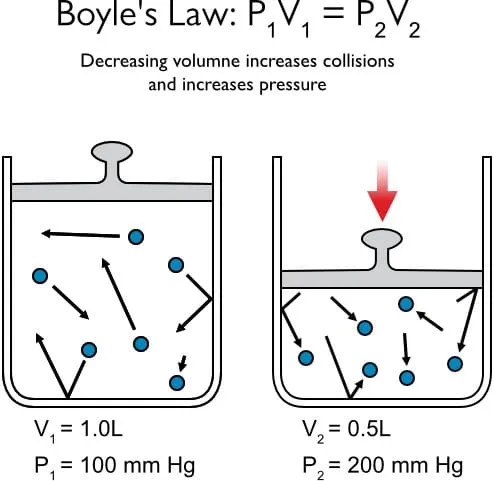
Boyle’s Law states that the pressure and volume of a fixed amount of gas are inversely proportional when its temperature is held constant. Squeeze the gas into half the space and its pressure doubles; let it expand to twice the space and its pressure halves.
Written as an equation, P × V stays constant, or P1V1 = P2V2: the starting pressure multiplied by the starting volume equals the new pressure multiplied by the new volume. The law describes an ideal gas, and air at factory pressures behaves very close to one. The pressures must be absolute, measured from a perfect vacuum, so air at sea level starts at about 1 bar rather than zero. Robert Boyle published the law in 1662, using apparatus built by his assistant Robert Hooke.
How does Boyle’s Law apply to compressed air?
An air compressor squeezes air into a smaller space to raise its pressure. That takes a lot of energy, and most of it never reaches the job.
The compressor draws in air at atmospheric pressure, about 1 bar absolute, and reduces its volume until the pressure reaches the level the site needs. Most factory systems run at around 6–7 bar gauge. At 7 bar gauge the air is at about 8 bar absolute, so by Boyle’s Law it occupies roughly one eighth of its original volume: around 8m³ of free air is squeezed into every 1m³.
Real compressors do not keep the temperature constant. The work done on the air heats it: approximately 80% of the electrical energy going to a compressor is converted into heat[1]. The air then has to be cooled, which condenses water out of it, so compressed air also needs drying and filtering before it is used.
At the point of use the process runs in reverse. When compressed air leaves a nozzle or Air Knife it expands back to atmospheric pressure, and the energy spent compressing it is not recovered. Taken from end to end, the overall efficiency of a typical compressed air system can be as low as 10–15%[2].
Why do Air Blowers use less energy than compressed air?
An Air Blower barely compresses the air, so far less energy is lost getting it to the Air Knife.
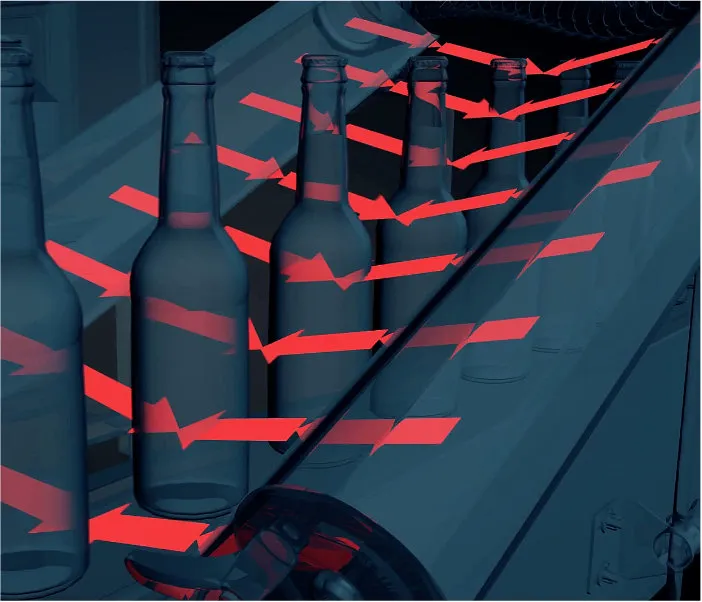
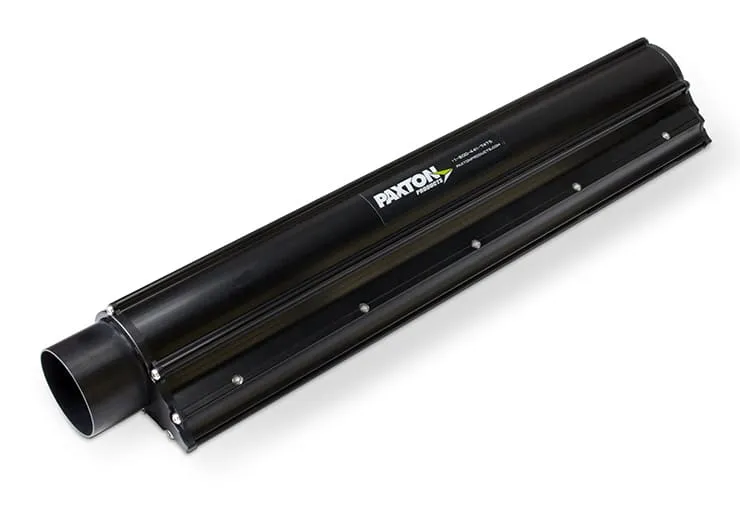
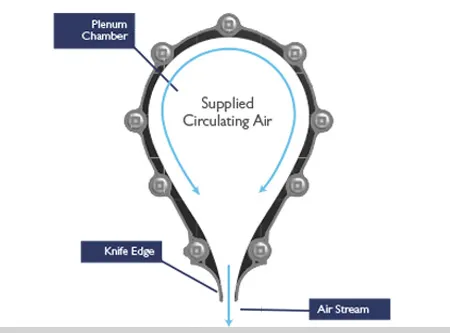
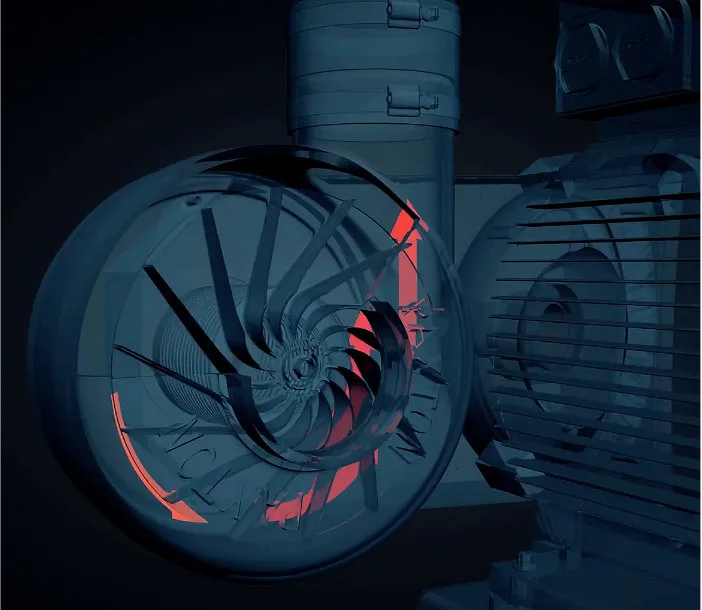
An Air Knife needs a high volume of air at high velocity, not high pressure. A Centrifugal Blower supplies exactly that, raising the air only slightly above atmospheric pressure. SolvAir’s standard Air Knife specification runs at 140 mbar, about 1.15 bar absolute, so by Boyle’s Law the air is reduced to about 88% of its original volume, against roughly 13% at 7 bar gauge.
Less compression means less work and less heat, there is no condensate to remove, and the blower makes air on demand rather than storing it in a receiver. That is why a blower-driven Air Knife System uses around 80% less energy than compressed air, and is typically 7–9 times cheaper to run.
See how the two compare on cost and performance in Compressed Air vs Air Blowers, or work out the figures for your own line with our Energy Savings Calculator.
Sources
- Natural Resources Canada, Energy Efficiency Reference Guide: Compressed Air.
- U.S. Department of Energy, Compressed Air Tip Sheet #1: Determine the Cost of Compressed Air for Your Plant (2004).
Related Air Knife Articles
Find out how Air Knives and Air Blowers turn low-pressure air into high-velocity air for drying, cleaning and blow-off, and where they are used across industry.